Dome permits and rules in Québec and Canada: what to check
Events, patios, glamping rentals or a backyard dome: the official Québec and federal rules to check, with sources, before you order.
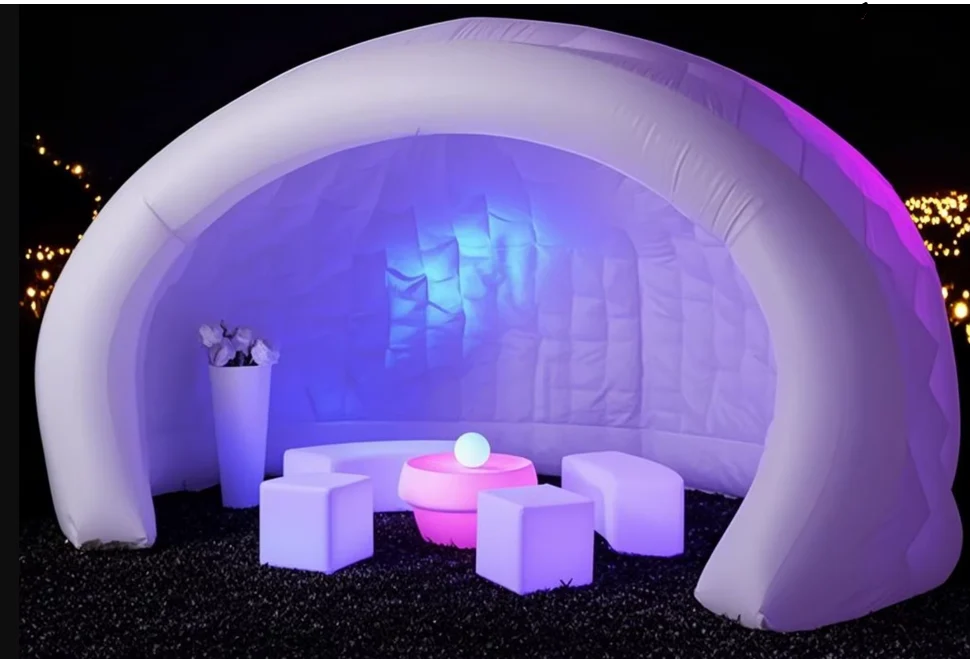
No single rule covers every dome in Québec. Requirements depend on the use (private yard, public event, tourist accommodation, commercial patio) and on the municipality. This guide gathers the official sources to check and summarizes what they actually say. It does not replace advice from your municipality or a qualified professional.
Four questions that decide which rules apply
- Will the public have access to the structure (event, business, rental)?
- Will it house tourists who pay to stay?
- Will it stand on private land or on public property (sidewalk, street, park)?
- How long will it stay up?
Public events under a tent or inflatable
The Régie du bâtiment du Québec (RBQ) has a page for event organizers, equipment owners and installers at outdoor events. It links to a guide that points to the regulations on buildings, gas, electricity and amusement rides. This is the provincial starting point.
Municipal fire departments also publish their own requirements. In Montréal, the fire department (SIM) page on tents and inflatable structures includes:
- solid anchoring to the ground according to the manufacturer's recommendations;
- at least 1.5 m from fire hydrants, Siamese connections and natural-gas control valves;
- two means of evacuation at least 1.5 m wide for structures over 150 m²;
- no cooking or combustion devices inside a tent the public can access;
- heating systems placed outside, at least 3 m from any tent or inflatable;
- tent fabric that complies with CAN/ULC-S109 or NFPA 701;
- for an inflatable used for a meeting of more than 200 people, an automatic emergency generator or a backup fan.
Québec City summarizes similar rules (in French):
- 3 m between a tent with a particular risk and any other element;
- flame-treated fabric;
- no cooking or combustion equipment in a tent or inflatable open to the public;
- a fire alarm system above 1,000 people.
Events on private land
Municipal zoning can apply even on private land. In Montréal's Ville-Marie borough, a chapiteau (heated or not) is among the temporary installations allowed for a public event on vacant private land. The borough asks organizers to notify the neighbourhood police station and the fire department 10 business days before the event. An event in a private courtyard, or a longer occupation, needs approval from the borough council, which the page says takes about 90 business days. Rules differ from one borough and city to the next.
Patios and public property
In Montréal, the public property occupancy permit covers commercial terraces, temporary structures and permanent elements that encroach on city property. The steps vary by borough. If you plan to put a dining pod on a patio, contact your borough first. The dining pod guide covers the other points to check.
Tourist accommodation: glamping domes and prêt-à-camper units
If you offer at least one accommodation unit to tourists, for pay, for periods of 31 days or less, you must register the establishment with the Québec government. The official page has a separate stream for camping and prêt-à-camper establishments, submitted through Camping Québec.
Before applying, you need an official document from the municipality confirming that the project complies with zoning rules. The page also requires, among other things:
- proof of ownership or the owner's authorization;
- civil liability insurance of at least $2,000,000 per occurrence;
- exterior and interior photos.
Our glamping site preparation guide turns these requirements into a checklist.
A dome in your own yard
For a dome in your backyard, the main rules are your municipality's zoning and building bylaws. These cover setbacks, accessory-building size, how long the structure may stay and foundations. They vary widely. Call the planning department with the model's dimensions and the intended location before you order.
The federal Tents Regulations
The Tents Regulations (SOR/2024-217), made under the Canada Consumer Product Safety Act, set flammability and labelling requirements for tents manufactured, imported, advertised or sold in Canada. They refer to standard CAN/CGSB-182.1.
Health Canada's industry guide explains the scope. A covered tent is portable, shelters people, is made of fabric, has a top and has at least one side that constrains egress. Structures subject to the National Building Code of Canada 2020 are excluded.
The guide also says the warning label must tell users the tent is not fireproof. If you are buying a camping tent, ask to see the model's label.
Checklist before you order
- Exact use, and whether the public will have access.
- A call to the municipal planning department (and the borough in Montréal).
- Fire department requirements for an event.
- Tourist accommodation registration if you rent the dome overnight.
- Manufacturer documentation: anchoring, fabric, limits of use.
Once you have these answers, add them to your quote request. We will tell you which documentation is available for the configuration you choose.
Frequently asked questions
Do I need a permit for a dome in my backyard?
It depends on your municipality. Zoning and building bylaws can regulate the size, location, duration and foundations of an accessory structure. Call the planning department with the model’s dimensions before you order.
Does a glamping dome rented to tourists need to be registered?
Yes, if you offer at least one unit to tourists, for pay, for 31 days or less. Québec has a camping and prêt-à-camper stream and first requires a municipal document confirming zoning compliance.
Can a tent or inflatable be heated at a public event?
In Montréal, the fire department prohibits cooking or combustion devices inside a tent the public can access. Heating systems must be outside, at least 3 m away. Check your own municipality’s rules.
What are the Tents Regulations?
They are federal regulations (SOR/2024-217) that set flammability and labelling requirements for tents sold in Canada, based on standard CAN/CGSB-182.1. Structures subject to the National Building Code are excluded.
Sources
- Régie du bâtiment du Québec — Outdoor events: fairs, carnivals and festivals (checked November 25, 2026)
- Service de sécurité incendie de Montréal — Tents and inflatable structures (checked November 25, 2026)
- Ville de Québec — Tente et chapiteau, fire prevention advice (in French) (checked November 25, 2026)
- Ville de Montréal — Public events on vacant private land or in a private courtyard, Ville-Marie (in French) (checked November 25, 2026)
- Ville de Montréal — Public property occupancy permit (checked November 25, 2026)
- Gouvernement du Québec — Registering a tourist accommodation establishment (in French) (checked November 25, 2026)
- Tents Regulations (SOR/2024-217) (checked November 25, 2026)
- Health Canada — Industry guide to Canadian safety requirements for tents (checked November 25, 2026)
Site conditions, permits, snow and wind loads, anchoring and seasonal suitability depend on the selected model. Confirm the model-specific documentation before making a project decision.
Have a project in mind?
The right model starts with your space, your needs and a clear conversation.
Tell us about it