Restaurant dining pods on a patio: layout, heating and permits
Plan dining pods like a small dining room: covers per pod, service route, ventilation, heating rules and municipal permits.
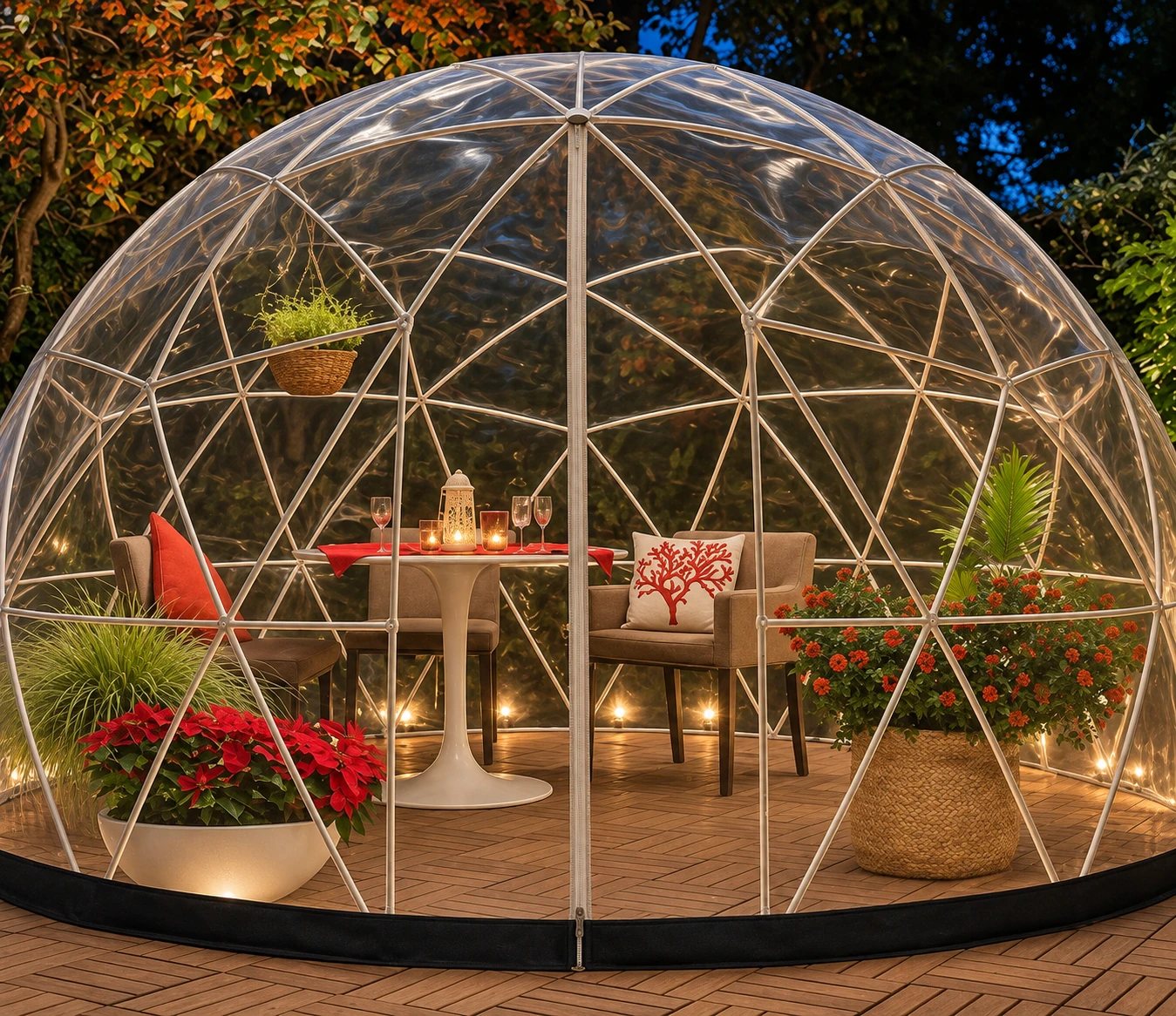
A restaurant dining pod on a patio is planned like a small dining room: the table, chairs pulled out, the server's route, ventilation and, often, a municipal permit. This guide uses our dining pod dome for restaurants (3.6 m in diameter and 2.2 m high according to its page) to show what to measure and what to check.
What the product page states
| Feature | As listed on the page |
|---|---|
| Size | 3.6 m diameter × 2.2 m height |
| Floor area | 10.2 m² (about 110 sq ft) |
| Materials | 0.8 mm optical-grade TPU, fiberglass-reinforced ABS frame |
| Anchoring included | 14 stakes and 14 sandbags |
| Weight and package | 18.5 kg; packed 80 × 40 × 40 cm |
Other claims on the page, such as light transmission and wind resistance, come from the supplier's documentation. Get written confirmation of the ones that matter for your use.
How many covers per pod?
Do not start from the number of people on a product page. Start from your table. On a 3.6 m circle, draw the table, the chairs pulled out and the door. Then check that the server can reach every seat without guests standing up. Headroom drops near the wall, so place chairs toward the centre rather than against the edge. The dome size guide explains the maths.
Placing pods on the patio
- Service route: walk from the kitchen to the farthest seat carrying a tray.
- Spacing: leave room between pods for anchors and sandbags.
- Accessibility: plan at least one pod reachable by a step-free route.
- Exits: pods must not block building or patio exits.
Ventilation, heat and condensation
A closed bubble traps heat and moisture in summer and winter alike. Air it out between seatings and allow time to dry. For heating, do not place any combustion appliance inside without approval from your fire department.
In Montréal, the fire department prohibits cooking or combustion devices inside a tent the public can access, and requires heating to be outside, at least 3 m away. Ask your city whether your pod is treated as a tent.
Permits and approvals
A commercial terrace on public property needs a permit. In Montréal, the public property occupancy permit covers commercial terraces and temporary structures, and the steps vary by borough. On a private patio, check zoning and signage bylaws. The permits and rules guide for Québec gathers the sources.
Cleaning and upkeep
- Clean clear panels as the manufacturer instructs, with products compatible with TPU.
- Dry before storage to prevent mould.
- Clear snow around and off the pod; do not let it build up.
- Check anchors before every seating in windy weather.
Season and storage
According to its page, the pod packs to 80 × 40 × 40 cm and 18.5 kg, so check your off-season storage space. For several pods, plan the setup and takedown order and the crew needed.
Checklist before you order
- Patio plan with pods, anchors and the service route.
- The borough's or city's answer on the permit.
- The fire department's position on heating.
- Number of pods and target opening date.
For several units or a special delivery, send a quote request. We confirm available quantity, freight and unloading in writing. To compare with event structures, read geodesic vs inflatable dome.
Frequently asked questions
How many people can sit in a 3.6 m dining pod?
It depends on your table and chairs. Draw the table with chairs pulled out on a 3.6 m circle, add the door and check that the server can reach every seat. Headroom drops near the wall.
Do patio dining pods need a permit?
On public property, yes. In Montréal, the public property occupancy permit covers commercial terraces and temporary structures, with steps specific to each borough. On private property, check municipal zoning.
Can a dining pod be heated?
Ask your fire department first. In Montréal, combustion appliances are banned inside a tent open to the public and heating must be outside, at least 3 m away. Plan ventilation as well.
Sources
- Service de sécurité incendie de Montréal — Tents and inflatable structures (checked November 25, 2026)
- Ville de Montréal — Public property occupancy permit (checked November 25, 2026)
Site conditions, permits, snow and wind loads, anchoring and seasonal suitability depend on the selected model. Confirm the model-specific documentation before making a project decision.
Have a project in mind?
The right model starts with your space, your needs and a clear conversation.
Tell us about it