Geodesic dome vs inflatable dome: which one fits your project?
Frame or air? Compare geodesic and inflatable domes on setup, power, anchoring and project length, with real models from the collection.
A geodesic dome stands on a rigid frame (steel or aluminum tubes, or panels), while an inflatable dome stands on air supplied by a blower. That one difference shapes almost everything else: setup, anchoring, power, how long the structure stays up and which projects it suits. This guide compares the two families using the models actually listed in our collection.
Geodesic vs inflatable dome: the short answer
| What to compare | Geodesic dome (frame) | Inflatable dome (air) |
|---|---|---|
| What holds it up | Assembled tubes or panels | Air pressure from a blower |
| Power | Not needed to stay standing | Needed for as long as the blower must run |
| Ground preparation | Wooden base or prepared surface, depending on the model | Flat, clear surface plus anchors and sandbags |
| Typical project length | Seasonal or longer installation | Events, rentals, brand activations |
| Examples in the collection | geodesic glamping dome, four-season dome tent | inflatable cube pavilion |
The table describes tendencies, not guarantees. Every model has its own limits, set out in its documentation.
How a geodesic dome works
Geodesic geometry divides the frame into triangles. For our geodesic camping and glamping dome, the product page lists a hot-dip galvanized steel frame (26 mm × 1.5 mm tubes), PVC covers and expansion screws for mounting on a wooden or prepared base, in 5, 6 and 8 metre sizes. It also states that the installation surface must be prepared.
Pole-supported dome tents such as the Shepherd four-season dome tent or the two-person extended dome tent belong to the same frame family in a lighter form: aluminum poles, stakes and guy lines instead of a fixed base.
When a geodesic frame is the better starting point
- The structure will stay in place for a season or longer.
- You do not want a power outage to put the structure at risk.
- You can build or prepare a level platform or base.
How an inflatable dome works
An inflatable dome is a fabric envelope held up by air. The product pages for our inflatable models list an included blower, anchors and, depending on the model, sandbags. The transparent bubble dome page says the dome takes about ten minutes to reach full shape and that gentle, continuous airflow must be maintained. The trampoline dome page refers to a continuous air blower.
When an inflatable is the better starting point
- You set up and take down often: events, rentals, trade shows.
- You have reliable power for the whole time the structure is in use.
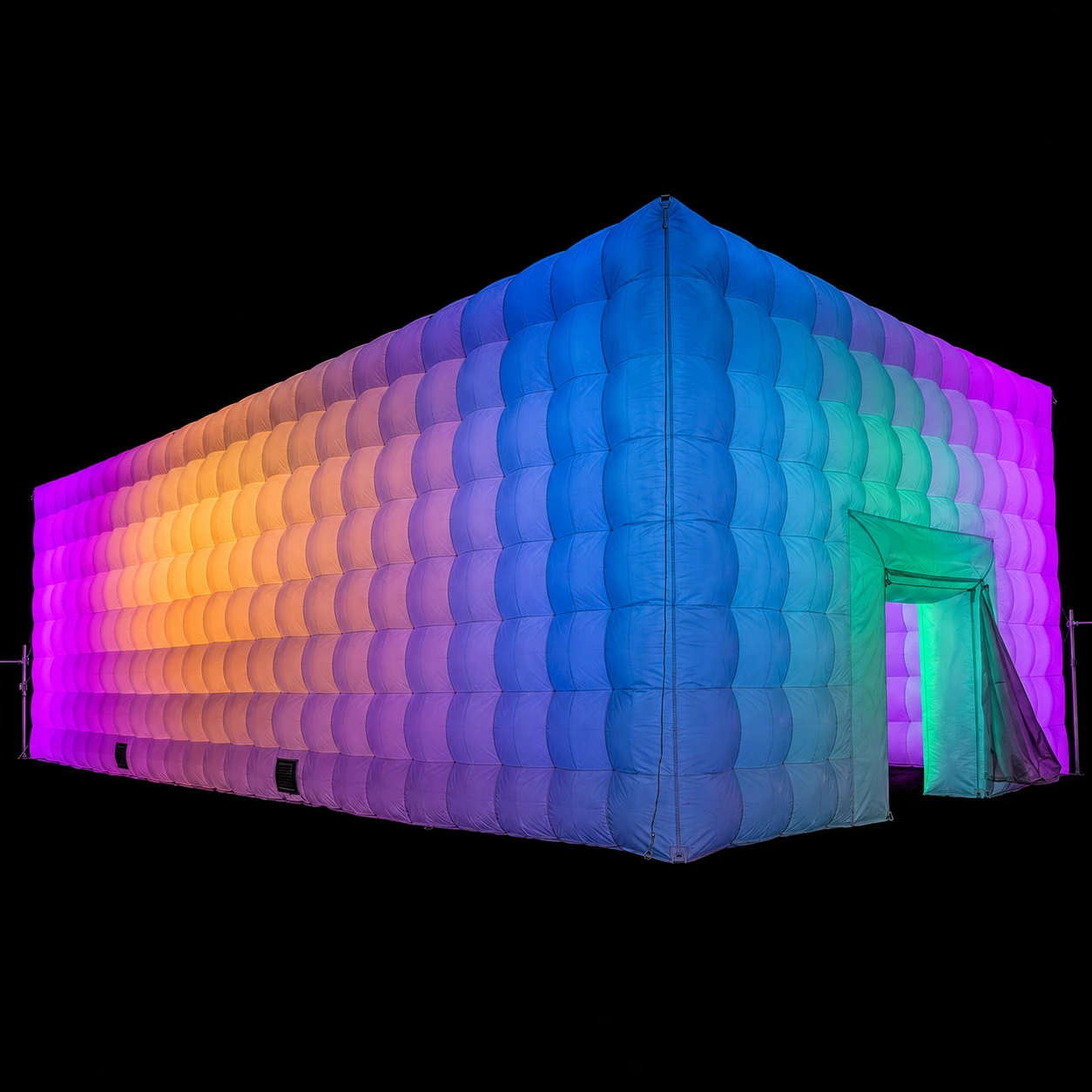
- You want a large open floor with no posts, like the inflatable cube pavilion offered in 5 × 5 m, 8 × 6 m and 10 × 10 m.
Power, noise and a backup plan
For an inflatable, ask for the blower's power rating, the voltage it needs, the extension length allowed and what happens to the structure if power is cut. Some cities require a backup for large gatherings. In Montréal, the fire department states that an inflatable structure used for a meeting of more than 200 people needs an automatic emergency generator or a backup fan (see our permits and rules guide).
Anchoring and wind
Both families must be anchored according to the manufacturer's instructions. A frame is fixed to a base. An inflatable is tied down with ropes, stakes and sandbags. Never replace a specified anchor with an improvised one. If a product page states a wind limit, ask which anchoring setup that figure assumes.
Which type suits which project?
| Project | Starting point | Read next |
|---|---|---|
| Glamping accommodation | Geodesic frame | Preparing a glamping dome site |
| Restaurant patio | Dining pod | Restaurant dining pod guide |
| Reception, launch, festival | Inflatable with lighting | Inflatable LED igloo dome |
| Winter camping with a stove | Dome tent with a chimney opening | Using a dome in winter |
Still undecided? Start with the dome size guide: the floor area you need often rules one option out.
Questions to ask before you choose
- What technical documentation exists for the exact configuration (size, cover, doors)?
- Which anchors are included and which do you need to supply?
- For an inflatable: must the blower run continuously, and what happens during a power cut?
- For a frame: what base is required and who installs it?
- What does the quoted price include, and which freight or import charges apply to your destination?
Send these questions with your quote request. We confirm the configuration, freight and delivery conditions in writing before any payment.
Frequently asked questions
Does an inflatable dome need to stay plugged in?
Depending on the model, yes. Our transparent bubble dome page says continuous airflow must be maintained. For each model, ask whether the blower must run at all times and what happens during a power cut.
Which one is faster to set up?
An inflatable usually goes up faster because there are no tubes to assemble. The transparent bubble dome page mentions about ten minutes to reach full shape. A geodesic frame also needs a prepared base.
Which one suits a full-season installation?
A geodesic frame is the usual starting point for a long installation because it does not depend on a blower. How long it can stay up still depends on the model documentation and your site conditions.
Sources
- Service de sécurité incendie de Montréal — Tents and inflatable structures (checked November 25, 2026)
Site conditions, permits, snow and wind loads, anchoring and seasonal suitability depend on the selected model. Confirm the model-specific documentation before making a project decision.
Have a project in mind?
The right model starts with your space, your needs and a clear conversation.
Tell us about it