Using a dome in winter: snow, wind and heating questions
Four-season does not mean a stated snow load. What to ask about snow, wind, anchoring on frozen ground, stoves and carbon monoxide.
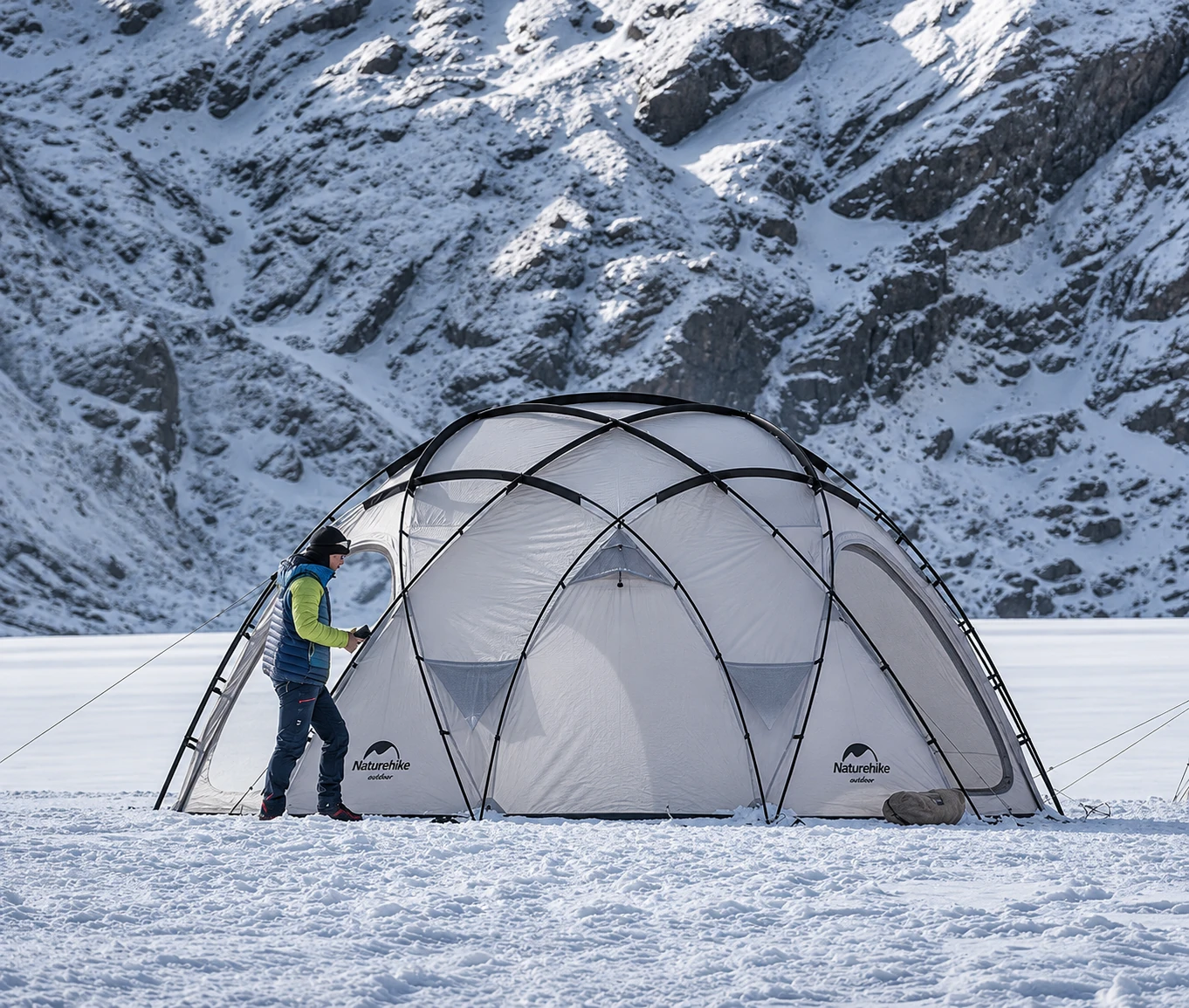
A dome can be used in winter, but only within the limits of its model. Labels such as “four-season” or “all-season” do not tell you how much snow or wind a structure can handle. Before using a dome from November to March, check three things: snow (load and clearing), wind (anchoring) and heating (a compatible appliance, and carbon monoxide).
Snow: what to ask
A rounded shape helps snow slide off, but it does not guarantee a load capacity. Conditions depend on the region, the exposure and how much snow builds up. Ask the supplier:
- whether a snow-load figure exists for the exact configuration, and how it was determined;
- how to clear snow (tools, frequency, at what depth);
- whether a liner or interior insulation changes how the structure behaves;
- what to do during a long absence: take it down, monitor it, or stop using it.
Our galvanized-steel glamping dome is installed on a base. Its product page notes that anchoring, permits and suitability for local conditions must be reviewed for your site. For a permanent or commercial installation, have the project reviewed by a qualified professional.
Wind and anchoring
A sheltered spot and an open field pose different challenges. When a product page states a wind figure, read it together with its conditions. The dining pod page says the pod stays secure in winds up to 70 km/h with its reinforced anchoring points, and lists a kit of 14 stakes and 14 sandbags. Ask whether that figure assumes every anchor is in place, and on what kind of ground.
In winter, frozen ground can make stakes impossible to drive. Plan a manufacturer-approved anchoring method for frozen ground, a slab or a platform.
Heating and carbon monoxide
Health Canada notes that carbon monoxide (CO) has no smell, taste or colour, and can only be detected with a CO alarm. Camping stoves and lanterns are among its sources, and using them where there is little airflow, such as a tent, raises the risk.
Three basic rules:
- Use only an appliance designed for the purpose, installed according to its own instructions and the structure's.
- A tent with a chimney opening, like the Shepherd dome tent or the two-person extended dome tent, is designed to take a compatible stove. The two-person tent page states that the stove and chimney are not included.
- At public events, municipal rules may ban any combustion appliance inside. In Montréal, heating must be outside, at least 3 m away (see the permits guide).
Condensation and ventilation
A heated dome produces condensation in winter from breathing, cooking and wet clothing. Plan vents and airflow even in deep cold. According to its product page, our glamping dome has round and triangular ventilation windows. In a tent, open the vents provided slightly rather than sealing everything shut.
Inflatables in winter
An inflatable dome depends on its blower. In winter, a power cut, accumulated snow or a blocked air intake can make the structure lose its shape. Ask whether the model is intended for winter use. Plan for outages, and never leave an occupied inflatable unattended.
Winter checklist
| Item | What to confirm |
|---|---|
| Snow | Load figure, clearing method and frequency |
| Wind | Stated figure and the anchoring it assumes; anchoring on frozen ground |
| Heating | Compatible appliance, chimney opening, CO alarm |
| Ventilation | Vents available, condensation management |
| Power | Blower, lighting, plan for outages |
| Local rules | Permits and bans at public events |
To go further, read geodesic domes and Canadian weather: five points to check, then send your location and dates of use with your quote request.
Frequently asked questions
Can a “four-season” dome handle Québec snow?
The label alone is not enough. Ask whether a snow-load figure exists for the exact configuration, how it was established and which clearing method is recommended. For a permanent installation, consult a professional.
Can I put a stove in a dome tent?
Only if the tent is designed for it, with a chimney opening, and with a compatible stove installed according to its instructions. Health Canada notes that carbon monoxide can only be detected with a CO alarm.
How do I anchor a dome on frozen ground?
Stakes are hard to drive into frozen ground. Ask the manufacturer for an approved anchoring method for frozen ground, a slab or a platform, and do not improvise substitutes for the specified anchors.
Sources
- Health Canada — Carbon monoxide (checked November 25, 2026)
- Service de sécurité incendie de Montréal — Tents and inflatable structures (checked November 25, 2026)
Site conditions, permits, snow and wind loads, anchoring and seasonal suitability depend on the selected model. Confirm the model-specific documentation before making a project decision.
Have a project in mind?
The right model starts with your space, your needs and a clear conversation.
Tell us about it